


In the delay function retrieves the previous value of a variable  . In the evaluation of Fib objects some branches will be evalued several times (e. g. for each value of an area element). The delay function will return the value, that it has taken before
  calls of the delay function.
Status: not implemented, planned for implementation
Syntax:

Description of the elements:
: The variable, which former value should be returned. The variable should be defined in the same branch as the Fib element of the delay function.
: An natural number, which determines, from which former delay-call the value of should be taken. If is no natural number, it will be rounded to a natural number.
 : The standard value which is given back, if there is no former value for .
 of an evaluation the value
  , of the variable . When the dalay function is called the
  'th time, it returns the value
  , which the variable had in the
  call. If is smaler as
  , the value of the subfunction will be returned.
An run is determined by the evaluation of the entire Fib object. For example, the evaluation of the Fib object over the top most root-element is a run. If such an evaluation over the top root-element is restarted, a new run is started and the delay function discards all previous values .
Example:
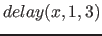 ; the variable
  is set to the value, it had in the former delay-call or to the value
  , if the delay function is evaluated for the first time (in the run).
Note:
With the delay function in connection with the set element, as well as area and function elements, for example, polygons can be easily generated. With the set-element, the edges of the polygon should be established. With the delay function the values for previous vertices are retrieved, which are then connected via divisional and functional elements.